Sunday, 18 October 2026
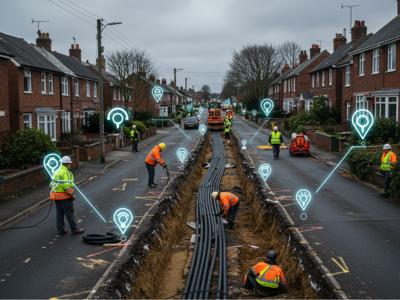
Openreach has taken a decisive step toward modernizing its fibre rollout strategy by deepening its partnership with Google Cloud. As the operator of the United Kingdom’s largest broadband network, Openreach has committed £15 billion to extend fibre coverage to 25 million premises by 2026. Achieving this scale within a constrained timeframe requires a fundamental shift in how networks are planned and deployed. AI now plays a central role in enabling this transformation.
Through Google Cloud’s advanced AI capabilities, Openreach can analyze complex infrastructure routes with a level of precision that manual methods cannot match. The system evaluates geographic data, urban layouts, and existing network constraints to identify optimal fibre paths. This reduces the need for repeated field assessments and minimizes costly delays during the planning phase. In addition, AI helps detect potential obstacles early in the process, allowing engineers to adjust strategies before construction begins. By integrating AI for fibre network rollout into its operations, Openreach is not only accelerating deployment but also improving the overall quality and reliability of its network infrastructure.
Beyond network planning, AI is also transforming the operational backbone of telecom deployment—fleet management. Openreach operates one of the largest commercial vehicle fleets in the United Kingdom, with approximately 24,000 vans traveling close to 200 million miles annually. Managing such a vast operation presents significant cost and sustainability challenges, particularly in an era where environmental accountability is becoming a core business priority.
By leveraging Google Cloud’s data analytics capabilities, Openreach is using AI to monitor driving patterns, reduce idle time, and optimize route efficiency. These insights enable the company to eliminate unnecessary travel and improve overall fleet utilization. The impact is both financial and environmental. Reduced fuel consumption translates directly into lower operational costs, while fewer emissions support broader sustainability targets. Openreach estimates that these AI-driven improvements have already cut around 10,000 tonnes of CO? emissions each year. This demonstrates how AI for fibre network rollout extends beyond infrastructure deployment to deliver measurable benefits across the entire telecom value chain.
One of the most transformative aspects of AI in telecom infrastructure lies in its ability to process and interpret large-scale geographic data. Openreach’s use of AI-powered mapping tools provides a clear example of how this capability can redefine network planning. By analyzing data from over 35 million homes and key transport corridors, AI systems offer planners an unprecedented level of visibility into the physical environment.
This level of detail allows telecom operators to make more informed decisions about where and how to deploy fibre networks. AI can identify the most efficient routes, prioritize high-demand areas, and highlight potential construction challenges before they arise. As a result, planning cycles become shorter and more cost-effective. The shift from manual mapping to AI-driven analysis represents a significant leap in efficiency. It enables telecom providers to scale operations without proportionally increasing complexity or resource requirements. In an industry where time-to-deployment is critical, AI-powered mapping is quickly becoming a competitive advantage.
Sustainability has moved from a secondary consideration to a central pillar of telecom strategy. As networks expand and data consumption increases, operators must address the environmental impact of their operations. AI is playing a crucial role in enabling this transition by optimizing resource usage and reducing unnecessary energy consumption.
Through intelligent route planning and operational insights, AI helps minimize fuel-intensive travel and supports the gradual shift toward electric vehicle fleets. It also enhances decision-making by identifying inefficiencies that would otherwise go unnoticed. These improvements contribute to a measurable reduction in carbon emissions, aligning telecom operations with global environmental goals. More importantly, they demonstrate that large-scale infrastructure expansion does not have to come at the expense of sustainability. By embedding AI into their workflows, telecom companies can build networks that are both high-performing and environmentally responsible.
AI for fibre network rollout is not limited to planning and logistics; it is also redefining day-to-day telecom operations. Google Cloud’s AI solutions provide real-time analytics and predictive insights that enable operators to manage their networks more effectively. This includes identifying potential faults before they escalate, optimizing workforce allocation, and improving the accuracy of deployment timelines.
By unifying data across multiple operational layers, AI creates a more cohesive and responsive system. Engineers, planners, and field teams can access the same insights, ensuring better coordination and faster decision-making. This level of integration reduces manual workloads and allows teams to focus on higher-value tasks. The result is a more efficient and resilient telecom infrastructure capable of meeting the demands of modern digital ecosystems.
Despite technological advancements, fibre rollout continues to face several persistent challenges. Manual planning processes, high capital requirements, and geographic constraints often delay deployment timelines. In addition, limited visibility into local conditions and inefficient fleet management can further complicate operations. These issues not only increase costs but also slow down the pace of broadband expansion.
AI offers a direct solution to many of these challenges. By automating data analysis and streamlining workflows, it reduces reliance on time-consuming manual processes. Advanced mapping tools provide clearer insights into local environments, while predictive analytics improve decision-making across the board. Fleet optimization minimizes unnecessary travel, reducing both costs and environmental impact. Together, these capabilities enable telecom operators to overcome traditional bottlenecks and accelerate network deployment in a more controlled and efficient manner.
Looking ahead, the role of AI in telecom infrastructure is set to expand significantly. The next generation of fibre rollout strategies will rely on AI-native systems capable of planning, executing, and optimizing operations with minimal human intervention. These systems will incorporate real-time data, predictive modeling, and automated decision-making to create highly adaptive networks.
Future developments are expected to include autonomous planning tools, self-optimizing network routes, and deeper integration with smart city ecosystems. As these technologies mature, telecom infrastructure will become more dynamic, resilient, and scalable. AI for fibre network rollout will not only accelerate deployment but also redefine how networks are managed over their lifecycle. In this evolving landscape, operators that successfully integrate AI into their strategies will be better positioned to meet growing connectivity demands while maintaining efficiency and sustainability.

Preety Shaha is a content writer at The Insight Partners, where she crafts research-backed press releases and market insights across industries. With a passion for storytelling and a sharp eye for detail, she transforms complex data into clear, engaging narratives. Her work empowers professionals to stay informed, make strategic decisions, and navigate fast-changing markets with confidence.

Smarter Decisions with Smart News
Smart Market News is committed to getting its readers the latest updates and insights on industries that help in making “smarter” business decisions. With insights and inputs from corporate decision makers, we bring you the stories of adopting innovative solutions and strategies that have been changing the world. Our editorial insights on products, solutions, companies, and adoption of best practices not only help in understanding the markets better, but also prove to be a complete package for your information needs.
 Can Navan turn travel tech trends into massive 2027 revenue?
  Apple American Manufacturing Program Adds New U.S. Partners