
Saturday, 10 October 2026
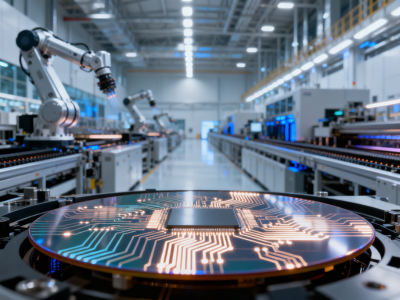
Competition to construct AI chip factories is intensifying as Elon Musk announced plans for two advanced semiconductor plants in Austin, Texas. According to Musk, Tesla and SpaceX will jointly develop these facilities to manufacture next-generation chips for AI data centers, electric vehicles, and humanoid robots. He emphasized that global chip production currently meets only a fraction of his company's projected needs, prompting an accelerated focus on domestic AI chip manufacturing.
Musk provided further details following the announcement of “Terafab,” a large-scale AI chip complex that will operate as two distinct fabrication facilities. Each facility will produce a custom AI chip: one designed for Tesla vehicles and the Optimus humanoid robot, and the other intended to power AI-driven satellites for SpaceX. Musk noted that the satellite chip must withstand elevated temperatures and maintain reliable performance in challenging environments.
The project marks the first time Musk has confirmed SpaceX’s role in chip development. SpaceX recently merged with its AI company xAI, further aligning AI infrastructure investment with aerospace priorities. He said his companies cannot rely on the current semiconductor ecosystem because the chip supply shortage limits growth across AI, robotics and satellite networks.
Musk added that suppliers such as Samsung, TSMC, and Micron remain vital partners, but their output cannot keep pace with demand from Tesla, SpaceX, and xAI. He said fresh investment in advanced semiconductor fabs is essential to support the future of AI hardware and expanding industry growth.
The Terafab project reflects Musk’s push to develop custom AI chips that deliver immense computing power. He said Terafab will eventually make one terawatt of computing capacity each year, which nearly doubles the amount produced across the United States today. This goal highlights how the future of AI hardware depends on larger, more advanced production lines that can meet rising demand from data centers and autonomous systems.
Tesla plans to use its new chip for AI-driven vehicle software and its humanoid robot program. Rising interest in robotics pushes companies to design chips that handle real-time decisions with high reliability. These humanoid robot chips will be built at one of the new facilities, creating a direct pipeline between Tesla research labs and chip manufacturing teams.
Meanwhile, SpaceX will use its specialized chip to upgrade AI capabilities for satellite networks. As satellite computing becomes more advanced, space-based AI chip development will help strengthen autonomous systems in orbit. Musk said these chips must support high-performance computing in extreme conditions, which requires custom designs that traditional fabs cannot supply quickly enough.
Musk did not disclose a comprehensive timeline for the project. Although his large-scale initiatives frequently encounter delays, he emphasized the necessity of rapid progress due to escalating demand. The global semiconductor supply chain remains under significant strain, with many companies struggling to obtain sufficient AI data center chips, edge AI processors, and high-performance computing chips to support expansion.
Despite ongoing uncertainty, the Austin complex represents a significant shift within the AI chip ecosystem. Musk now positions Tesla, SpaceX, and xAI as semiconductor manufacturers rather than purchasers, a move that may encourage other companies to invest in their own fabrication facilities as AI workloads increase across industries.
Moreover, the broader semiconductor industry continues to expand. The Semiconductor Manufacturing Equipment Market is growing as companies upgrade factories, adopt new lithography tools and invest in AI-optimized production lines. Manufacturers now pursue strategies that increase output, reduce bottlenecks and support the next generation of AI-focused chips. Musk’s plan underscores one message: the future of AI depends on enormous computing power, and current production cannot meet the demand. With new AI chip factories in Austin, Tesla and SpaceX hope to secure a long-term advantage as global competition for advanced chips intensifies.

Preety Shaha is a content writer at The Insight Partners, where she crafts research-backed press releases and market insights across industries. With a passion for storytelling and a sharp eye for detail, she transforms complex data into clear, engaging narratives. Her work empowers professionals to stay informed, make strategic decisions, and navigate fast-changing markets with confidence.

Smarter Decisions with Smart News
Smart Market News is committed to getting its readers the latest updates and insights on industries that help in making “smarter” business decisions. With insights and inputs from corporate decision makers, we bring you the stories of adopting innovative solutions and strategies that have been changing the world. Our editorial insights on products, solutions, companies, and adoption of best practices not only help in understanding the markets better, but also prove to be a complete package for your information needs.
 Can Navan turn travel tech trends into massive 2027 revenue?
  Apple American Manufacturing Program Adds New U.S. Partners