
Sunday, 18 October 2026
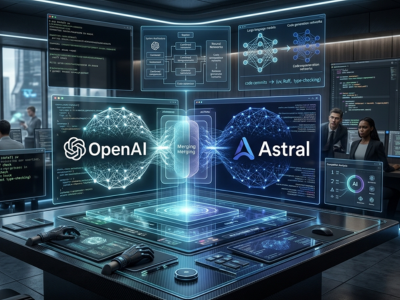
The AI ecosystem is expanding at a pace that leaves even seasoned developers and investors proceeding cautiously. OpenAI’s Astral Acquisition, a fast-growing Python tooling startup, marks a turning point in the AI acquisition strategy landscape. But behind the excitement lies a deeper question: Is this a bold step toward scalable AI-assisted coding, or a defensive move in a rapidly intensifying competitive environment?
OpenAI confirmed it will acquire Astral, bringing core Python tools such as uv, Ruff, and ty into the Codex ecosystem to strengthen its position in the AI developer tools market. The acquisition folds Astral’s team directly into Codex, a deliberate strategy designed to counter rising competitive pressure from Anthropic’s Claude Code and the AI-native Editor Cursor. In a market where developer mindshare determines platform survival, OpenAI’s purchase is more than a business decision; it is a repositioning of the AI software engineering terrain.
Astral’s suite of Python tools is deeply embedded in the Python ecosystem, running quietly on millions of developer machines and serving as the foundational layer of modern software projects. Astral’s tools routinely clock hundreds of millions of downloads per month, reflecting their widespread adoption across real-world production environments. This makes Astral not just another acquisition but a strategic absorption of the very tools that developers rely on daily. The trio at the center of the deal includes:
These tools cover significant portions of the software development lifecycle, from dependency management to linting, formatting, and type safety. Their integration with Codex signals OpenAI’s plan to support AI-assisted coding that is deeply tied into the mechanics of Python itself. OpenAI confirmed that it will continue supporting these tools as open source projects, aligning with its “developer first philosophy. Astral’s CEO, Charlie Marsh, echoed this commitment to open source continuity.
The acquisition must be viewed through the lens of intensifying market competition. Codex is under pressure from: Anthropic’s Claude Code, known for advanced reasoning in code generation tasks, Cursor, the AI native code editor, gaining momentum among modern developers
CNBC reports that Codex has more than 2 million weekly active users, with usage tripling in a matter of months, strong numbers, but ones OpenAI fears may stall without deeper integration into everyday developer workflows. The Astral acquisition gives OpenAI something Anthropic lacks: direct ownership of essential developer workflow tools that shape how Python projects are structured, managed, and maintained. This acquisition is as much a defensive move as it is an accelerative one.
The AI boom is rapidly transforming how code is written. Developers increasingly expect AI coding assistants to do more than generate snippets they want tools that:
This is where Astral’s toolchain becomes vital. OpenAI says the integration will expand Codex’s capabilities beyond code generation to support AI-powered development workflows such as modifying codebases, planning changes, verifying results, and maintaining software. The New Stack further confirms that OpenAI aims to transform Codex from a generative engine into a full-stack development agent that interacts directly with the tools developers rely on every day. This marks a shift toward agentic AI in development, where AI agents participate actively throughout the development lifecycle rather than merely responding to human prompts.
The very foundation of modern programming faces a profound transformation. Python serves as the essential architecture for artificial intelligence and the invisible infrastructure of the global digital landscape. At the heart of this world reside the tools developed by Astral specialized utilities for linting, package management, and type-checking. These instruments have become the silent engines driving the productivity of millions, and their sudden migration to a new corporate guardian sends a tremor through the community.
The scale of this transition is immense. With monthly downloads reaching staggering volumes, these projects represent the primary arteries of Python development. By bringing these instruments under its umbrella, OpenAI has moved from a participant in the ecosystem to its primary architect. This consolidation creates a crossroads shrouded in both immense potential and lingering apprehension.
One possible future suggests an era of unprecedented development. With vast resources, the new parent organization could refine these tools into a seamless, high-performance suite integrated with advanced language models. Yet, an unsettling shadow looms for the open-source faithful. Questions regarding long-term stewardship and the potential for corporate interests to stifle organic evolution remain unanswered. While assurances of transparency have been offered, the community remains in a state of watchful waiting, aware that the tools they rely upon are now subject to a single, powerful strategic vision.
This deal highlights a trend growing across the industry: AI is moving from assisting developers to becoming an infrastructure layer within software engineering itself. Technology Magazine observes that by embedding Astral’s tools into Codex, OpenAI can power the entire development lifecycle planning, coding, executing tools, verifying correctness, and maintaining code. This is a step toward next-generation AI-powered development workflows, where manual coding tasks gradually shift toward automated, AI-orchestrated systems. This shift also aligns with the rapid evolution of the DevOps market, where automation, continuous integration, and deployment pipelines are increasingly powered by AI-driven tooling. As AI integrates deeper into development workflows, the boundary between software engineering and DevOps is beginning to blur.
Meanwhile, the acquisition is OpenAI’s attempt to become a vertically integrated AI development powerhouse, tying together coding, infrastructure, and open-source ecosystems under one strategic umbrella. AI will not replace developers, but developers who use deeply integrated AI systems may replace those who do not.
While the deal aligns with OpenAI’s ambitions, it also introduces risks:
Cautious analysis suggests that although Acquisition may accelerate AI platform growth, it also centralizes influence over tooling used by millions of developers, a structural shift that needs careful monitoring.
OpenAI’s Astral Acquisition is not merely a transaction; it is a strategic reconfiguration of how developers, tools, and AI systems interact. It strengthens OpenAI’s position in the rapidly evolving market for AI-assisted coding, brings essential tools into Codex, and deepens the company’s reach into the Python ecosystem.
But the move also signals a future where AI becomes tightly woven into the software development lifecycle itself, from planning and coding to maintaining entire codebases. The acquisition could empower millions of developers. It could also consolidate too much influence in too few hands. In this new era of AI-powered development, innovation and caution must go hand in hand.

Preety Shaha is a content writer at The Insight Partners, where she crafts research-backed press releases and market insights across industries. With a passion for storytelling and a sharp eye for detail, she transforms complex data into clear, engaging narratives. Her work empowers professionals to stay informed, make strategic decisions, and navigate fast-changing markets with confidence.

Smarter Decisions with Smart News
Smart Market News is committed to getting its readers the latest updates and insights on industries that help in making “smarter” business decisions. With insights and inputs from corporate decision makers, we bring you the stories of adopting innovative solutions and strategies that have been changing the world. Our editorial insights on products, solutions, companies, and adoption of best practices not only help in understanding the markets better, but also prove to be a complete package for your information needs.
 Can Navan turn travel tech trends into massive 2027 revenue?
  Apple American Manufacturing Program Adds New U.S. Partners