Saturday, 10 October 2026
Percutaneous coronary intervention device technology drives modern interventional cardiology and helps clinicians restore blocked coronary arteries effectively. Clinicians use each percutaneous coronary intervention device to improve blood flow, reduce symptoms, and enhance long-term cardiovascular outcomes. This blog explains essential tools, procedural steps, and emerging innovations shaping the global percutaneous coronary intervention device landscape.
A percutaneous coronary intervention device supports minimally invasive treatment that opens narrowed or obstructed coronary arteries safely. Physicians perform PCI under imaging guidance and advance each percutaneous coronary intervention device through small vascular access points. They remove plaque, compress arterial blockages, and restore healthy circulation to prevent myocardial damage.
Initially, clinicians relied on simple balloon angioplasty to dilate narrowed vessels during early PCI development. However, technological advances introduced stents, imaging systems, and specialized tools that improved procedural precision. Consequently, modern percutaneous coronary intervention device platforms now address complex lesions with greater reliability.
Clinicians typically begin PCI by accessing the radial or femoral artery using sterile techniques. Next, they advance diagnostic and guide catheters toward the coronary arteries under fluoroscopic visualization. After crossing the lesion with a guidewire, they deliver balloon catheters or stent systems. Throughout the procedure, real-time imaging confirms proper positioning and ensures optimal percutaneous coronary intervention device deployment.
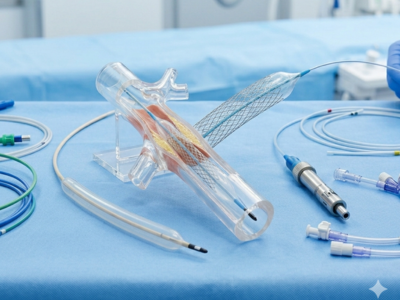
Coronary catheters form the foundation of every PCI and support safe vascular navigation. Each percutaneous coronary intervention device catheter enables contrast injection, vessel visualization, and stable delivery of interventional tools. Physicians rely on diagnostic catheters for imaging and guide catheters for therapeutic support.
Diagnostic catheters allow clinicians to evaluate lesion severity before selecting the appropriate percutaneous coronary intervention device strategy. Guide catheters, however, provide structural support while balloons and stents cross complex anatomy. As a result, catheter design significantly influences procedural efficiency and safety.
Manufacturers produce both over-the-wire and rapid-exchange catheter systems for varied clinical needs. Over-the-wire systems provide flexibility during device exchanges in challenging anatomies. In contrast, rapid-exchange systems simplify handling and reduce procedure time. Inflation devices and Y-connectors further enhance control and minimize blood loss during catheter manipulation.
Guide wires represent another critical percutaneous coronary intervention device category that enables lesion crossing. Physicians advance these thin, flexible wires through tortuous vessels to establish a stable pathway. Without a properly positioned guide wire, no other percutaneous coronary intervention device can reach the blockage.
Engineers design guide wires with varying stiffness, coatings, and tip configurations to address diverse lesion types. For example, hydrophilic coatings improve trackability through narrow segments and calcified plaques. Additionally, specialty wires help clinicians manage chronic total occlusions and bifurcation lesions.
In complex cases, operators introduce microcatheters over the guide wire to improve support. These adjunctive tools enhance torque control and facilitate accurate device advancement. Therefore, guidewires remain central to procedural success across routine and high-risk PCI interventions.
Balloon catheters function as essential percutaneous coronary intervention device components for vessel dilation. When positioned at the stenotic site, the balloon inflates under controlled pressure. This inflation compresses plaque against the arterial wall and increases luminal diameter.
Balloon angioplasty established the groundwork for contemporary PCI practice decades ago. Today, clinicians use semi-compliant and non-compliant balloons to tailor expansion force precisely. Furthermore, scoring and cutting balloons address resistant or calcified lesions effectively.
In many procedures, balloons also serve as delivery platforms for stent placement. The stent mounts on the balloon and expands as the balloon inflates. Consequently, the balloon catheter plays a dual therapeutic and delivery role in modern percutaneous coronary intervention device systems.
Stents remain one of the most recognized percutaneous coronary intervention device innovations in cardiology. These expandable mesh tubes support arterial walls after balloon dilation and prevent vessel recoil. Physicians deploy stents to sustain patency and reduce the risk of restenosis.
Bare-metal stents provide mechanical scaffolding without pharmacological coatings. However, drug-eluting stents release medication that limits tissue proliferation within the treated segment. As evidence accumulated, drug-eluting platforms became standard in many clinical scenarios.
During deployment, clinicians advance the stent-mounted balloon to the lesion and expand it precisely. After expansion, they withdraw the balloon while leaving the stent permanently implanted. Thus, the stent acts as a structural framework that maintains improved coronary blood flow.
The percutaneous coronary intervention device market continues to expand as coronary artery disease remains prevalent worldwide. Growing procedure volumes and aging populations contribute to sustained demand for advanced PCI technologies. Therefore, manufacturers invest heavily in research and development initiatives. Innovations include thinner stent struts, enhanced polymer coatings, and bioresorbable scaffold concepts. Additionally, companies integrate artificial intelligence into imaging platforms to improve lesion assessment. These digital tools assist physicians in selecting the most appropriate percutaneous coronary intervention device configurations.
Percutaneous coronary interventions, commonly called coronary angioplasties, serve as a primary treatment option for coronary artery disease and generally require a balloon catheter and a coronary stent. With more than one million PCI procedures performed annually in the United States and volumes continuing to increase, related device markets, including interventional catheters, guidewires, and other procedure-specific tools, are expected to experience sustained growth. Artificial intelligence further enhances intraprocedural imaging and quantitative coronary analysis. These systems improve visualization and guide accurate device sizing decisions. As a result, clinicians achieve better alignment between lesion characteristics and percutaneous coronary intervention device selection.
Beyond standard tools, adjunctive percutaneous coronary intervention device technologies address complex procedural challenges. Embolic protection devices capture debris released during plaque disruption. By preventing distal embolization, these systems protect downstream myocardial tissue.
Atherectomy devices remove heavily calcified plaque that balloons alone cannot adequately expand. Operators use rotational or orbital systems to modify lesion morphology before stent placement. Therefore, plaque modification expands the range of treatable coronary anatomies.
Percutaneous coronary intervention device technologies encompass a comprehensive array of tools that transform cardiovascular care. Catheters, guide wires, balloons, and stents work together to reopen blocked arteries efficiently. Moreover, adjunctive and mechanical support systems enhance safety during complex interventions.
As technology advances, each new percutaneous coronary intervention device iteration improves precision and long-term outcomes. Continued innovation, expanding clinical adoption, and digital integration will further strengthen PCI practice globally. Ultimately, these coordinated advancements reinforce the central role of percutaneous coronary intervention device solutions in modern cardiology.

As a skilled content writer with expertise in SEO, Mursalin Pathan specializes in creating high-quality, optimized blog posts, articles, and web content that help brands stand out in the digital landscape. Her commitment is to craft compelling content that not only captivates readers but also boosts search engine rankings, ensuring businesses connect effectively with their target audience and drive measurable growth.

Smarter Decisions with Smart News
Smart Market News is committed to getting its readers the latest updates and insights on industries that help in making “smarter” business decisions. With insights and inputs from corporate decision makers, we bring you the stories of adopting innovative solutions and strategies that have been changing the world. Our editorial insights on products, solutions, companies, and adoption of best practices not only help in understanding the markets better, but also prove to be a complete package for your information needs.
 Natera Launches Zenith Genomics for Rare Disease in US Healthcare
  Pet Diabetes Explained: Causes, Signs & Care Tips